
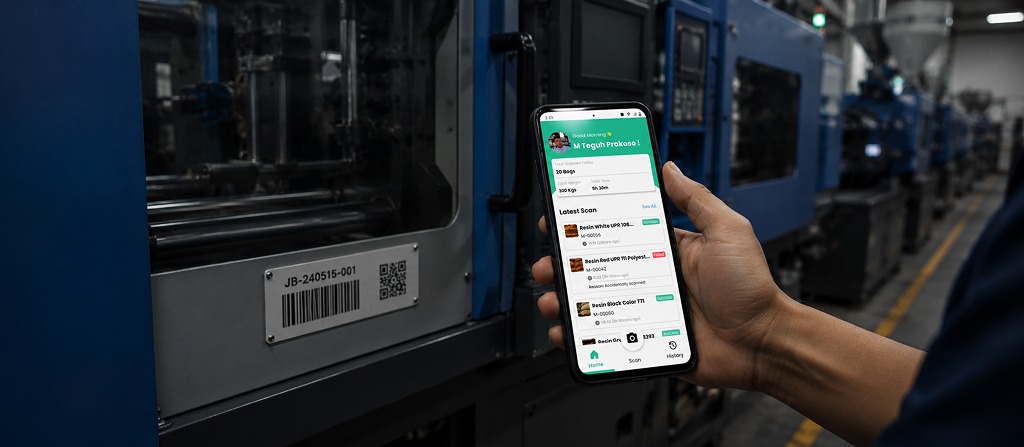
Designed and developed the first Android application for JST Indonesia, transforming a hardware-dependent production workflow into a mobile-first experience that reduced material validation time by nearly 40% while lowering device procurement costs by approximately $260 per unit.
01. Manufacturing Context
Before m-JPM, production operators relied on handheld barcode scanners connected to laptops to validate raw materials before entering the manufacturing process.
While the workflow was functional, it introduced several operational inefficiencies. Barcode scanners frequently lost connection once operators moved beyond their transmission range, forcing them to repeatedly return to a workstation just to confirm whether the scanned data had been successfully recorded.
At the same time, maintaining dedicated barcode scanners became increasingly expensive. Each device required regular maintenance and replacement parts, making it difficult to scale as production needs continued to grow.
To modernize this workflow, the company initiated its first Android application within the Molding Department leveraging smartphones as a more affordable and reliable alternative supported by the factory’s existing wireless infrastructure.
![[GANTI INI: deskripsi gambar yang informatif]](https://andiastika.com/wp-content/uploads/2026/07/05-mJpm-1.jpg)
02. Understanding the Problem
Since this application was developed for internal operations, research focused on understanding how production teams actually worked on the factory floor rather than collecting broad user feedback.
I conducted multiple observation sessions inside the Molding Department and interviewed three key stakeholders who interacted with the production process from different perspectives.
- Operators shared how unstable scanner connectivity interrupted their daily workflow.
- Supervisors explained how production status was monitored and validated.
- Managers provided operational goals and highlighted the business impact of production errors.
These conversations helped us identify that the problem wasn’t simply the barcode scanner, it was the workflow surrounding it.
Material validation happened too late, device connectivity wasn’t reliable, and operators had to spend unnecessary time moving back and forth between production lines and workstation computers.
![[GANTI INI: deskripsi gambar yang informatif]](https://andiastika.com/wp-content/uploads/2026/07/03-mJPM-1.png)
03. Translating Strategy into a Practical Solution
The decision to replace handheld barcode scanners with Android smartphones had already been established as the project’s strategic direction.
My responsibility was to understand operational needs and translate that vision into an application that production teams could confidently adopt.
Working closely with operators, supervisors, and the Front-End Developer, I designed and developed an Android application capable of:
- Scanning barcodes directly using the smartphone camera
- Validating raw materials before production began
- Providing immediate confirmation after every successful scan
- Supporting wireless connectivity across multiple access points inside the factory
Instead of simply replacing one device with another, the project rethought how validation should happen within the production workflow.
By validating materials before production started, potential mistakes could be identified much earlier and prevented costly downstream errors.
![[GANTI INI: deskripsi gambar yang informatif]](https://andiastika.com/wp-content/uploads/2026/07/03-mJPM.png)
04. From Pilot to Production
Introducing a new operational workflow inside a manufacturing environment required careful implementation.
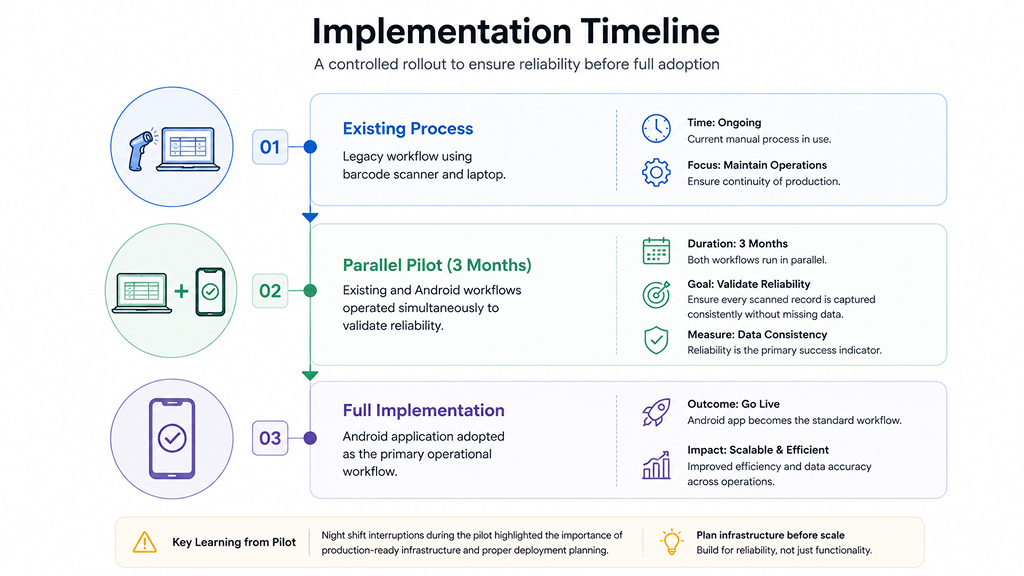
Rather than replacing the existing process immediately, the team ran a three month parallel pilot, where both handheld barcode scanners and the Android application were used simultaneously.
The primary success indicator wasn’t speed, it was reliability.
The migration would only continue once every scanned record could be consistently captured without missing production data.
One unexpected challenge emerged during the pilot phase.
Since the early prototype was temporarily hosted on my development machine, operators working night shifts occasionally experienced interruptions whenever server issues occurred outside working hours.
Although temporary, this experience reinforced the importance of deployment planning and production ready infrastructure before scaling digital products.
05. Outcome
The implementation successfully modernized the material validation process while reducing both operational effort and hardware costs.
Scanning time decreased from 33 minutes to 20 minutes, allowing operators to continue production without repeatedly returning to workstation computers.
Replacing handheld barcode scanners with Android smartphones reduced procurement costs by approximately $260 per device, while also lowering long-term maintenance expenses.
m-JPM became the first Android application introduced within JST Indonesia, establishing a new approach to internal production digitization.
While static screens explain the interface, this short walkthrough shows how the experience works in practice.
06. Reflection
Looking back, this project marked the beginning of my journey into Product Design.
At the time, my primary focus was delivering a working solution as both a UI/UX Designer and Back-End Engineer. My research activities were practical and driven by immediate implementation needs rather than structured UX methodologies.
If I approached the same project today, I would invest more time in documenting user research, mapping operational workflows, and validating assumptions before moving into design.
While the application successfully improved operational efficiency, this experience taught me that good product decisions begin long before interface design, they begin with understanding how people actually work.
That lesson continues to shape how I approach every product I design today.
"Good product decisions begin long before interface design, they begin with understanding how people actually work."
Want to discuss this project?
I’d love to talk through the process, the decisions, and the lessons learned.