
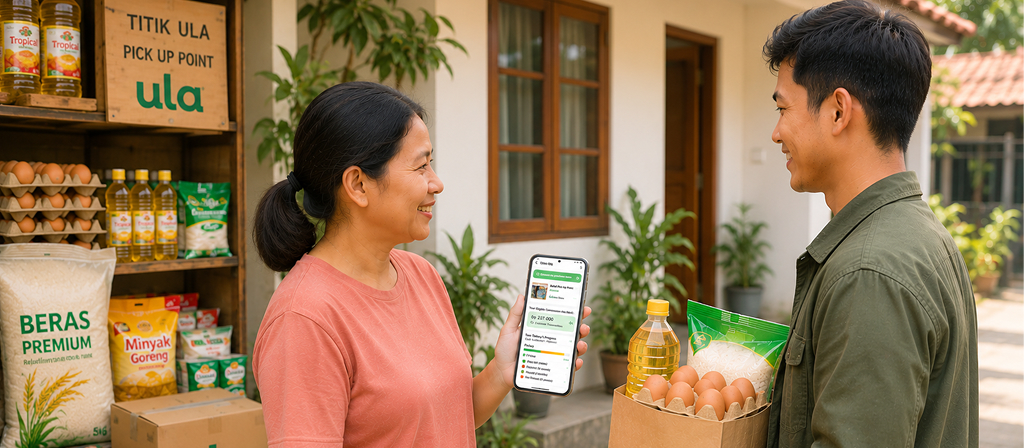
Designed an Android app that enabled community pickup partners to manage deliveries, helping reduce logistics costs while creating a more efficient last-mile fulfillment experience.
01. The Challenge
Direct door-to-door delivery provided convenience for customers, but it also introduced higher operational costs and longer delivery times. As Ula expanded, scaling this delivery model became increasingly inefficient.
To address this challenge, Ula introduced Titik Ula, a new business model where local community members could turn unused spaces in their homes or shops into Pickup Points. Customers choosing this delivery option benefited from lower shipping costs, while Pickup Point Partners earned additional income for every completed order.
The challenge was designing a digital product for an operational model that had never existed within Ula before. With limited benchmarks and an evolving service flow, the product needed to support daily pickup operations while remaining simple enough for first-time partners.
![[GANTI INI: deskripsi gambar yang informatif]](https://andiastika.com/wp-content/uploads/2026/08/05-Titik-Ula.jpg)
02. Translating Operations into Product
As Product Designer, I worked closely with the Product Manager and UX Researcher to translate operational workflows into an Android application for Pickup Point Partners.
My contribution focused on contextual inquiry, customer journey mapping, interface design, developer handoff, and product discussions throughout the project. Rather than designing individual screens, my role was to ensure the application reflected the real operational activities happening at every pickup location.
Because the operational model was still evolving, many design decisions required close collaboration with cross functional stakeholders instead of relying solely on existing design patterns.
![[GANTI INI: deskripsi gambar yang informatif]](https://andiastika.com/wp-content/uploads/2026/08/02-Titik-Ula.jpg)
03. Designing Around Daily Operations
The application supported Pickup Point Partners throughout their daily responsibilities from receiving deliveries and confirming customer pickups to tracking commissions earned from completed transactions.
The Information Architecture organized these activities into several key areas, including incoming deliveries, pickup confirmation, commission history, and order management, allowing partners to complete their work from a single application.
![[GANTI INI: deskripsi gambar yang informatif]](https://andiastika.com/wp-content/uploads/2026/08/03-TitikUla.png)
![[GANTI INI: deskripsi gambar yang informatif]](https://andiastika.com/wp-content/uploads/2026/08/04-Titik-Ula.png)
04. Validating the Experience
After the first prototype was presented, usability testing was conducted by the UX Research team with Pickup Point Partners. The findings highlighted several operational challenges that could not have been anticipated during the initial design phase.
Rather than exposing interface usability issues alone, the research uncovered how real world operational behaviors affected the overall service experience. These insights became valuable inputs for future product iterations.
And the findings are written below:
Partners experienced inconsistent delivery arrival times, making it difficult to manage customer expectations.
Customers often misunderstood the purpose of PIN verification, especially when someone else collected the order on their behalf.
Partners felt uncomfortable asking customers to take verification photos during pickup, creating unnecessary friction.
Subsequent iterations introduced QRIS payments to accommodate customers who initially selected cash but preferred paying digitally during pickup.
05. Outcome
Although my involvement concluded before later iterations were released, the project established the foundation for Titik Ula’s Pickup Point operations.
One important design decision was allowing photo or PIN verification to remain optional rather than mandatory. Early usability findings later confirmed that this flexibility helped reduce friction during order collection while accommodating various pickup scenarios.
More importantly, the project reinforced that designing operational products requires understanding not only interface interactions, but also the people, workflows, and constraints surrounding the service itself.
06. Lesson Learned
This project taught me that operational assumptions should always be validated through real world usage.
Some challenges including customer misunderstanding of PIN verification, privacy concerns around photo validation, and changing payment preferences only became visible after the product reached actual Pickup Point Partners. Those insights reinforced the importance of designing flexible systems that can evolve alongside operational needs instead of assuming every scenario can be predicted during the initial design phase.
Want to discuss this project?
I’d love to talk through the process, the decisions, and the lessons learned.