01. Overview
Ula wanted to understand the people behind Indonesia’s warung ecosystem, not simply what they sold, but how they operated, what motivated them, and what made some businesses more likely to grow and sustain themselves.
I joined a 12 person research and design team conducting field research across five cities in Indonesia.
The goal was to build a deeper understanding of warung owners that could inform future retailer targeting, segmentation, acquisition, product strategy, and programs for warung owners.
02. My Contribution
This was not a small qualitative study. The research team needed to understand patterns across a large and diverse set of warung businesses.
We divided 12 researchers into six field teams and visited predetermined areas across:
JaDeTaBek · Bandung · Semarang · Yogyakarta · Malang · Surabaya · Bali
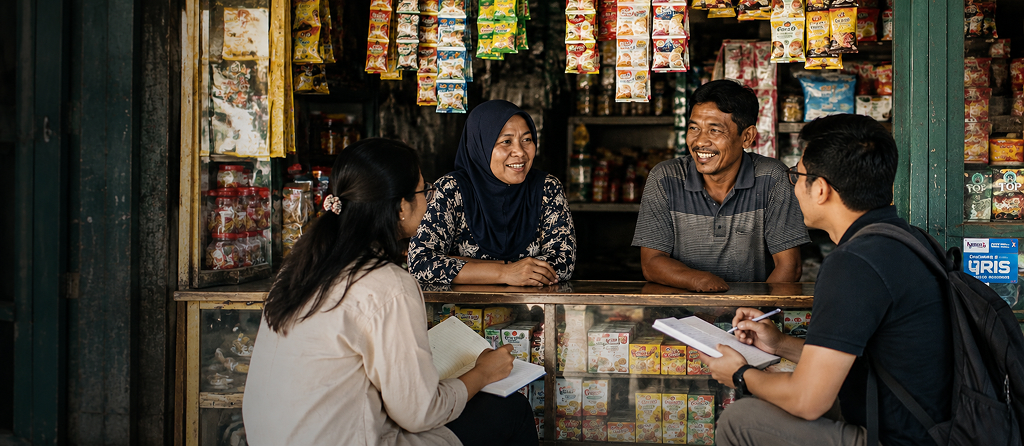
Each researcher walked through selected areas and approached warung owners using a shared interview guide.
Based on the team’s field experience, approximately 1 in 4 warung owners agreed to participate, resulting in roughly 273 completed interviews/observations from around 816 approaches.
I personally visited approximately 40 warungs across the research period.
My contribution included:
- Conducting in-depth interviews
- Observing store operations
- Capturing contextual details
- Following the shared research guide
- Bringing field observations into synthesis
- Participating in the 10-day workshop
- Contributing to the identification and classification of behavioral patterns
- Helping translate findings into a framework that could support business and product decisions
04. From Fieldwork to Synthesis
After the fieldwork, the research and design teams came together for a synthesis workshop lasting approximately 10 days.
Instead of analyzing each interview independently, we brought observations from different cities and researchers together to identify recurring behaviors, motivations and characteristics.
The team looked for similarities across the data:
- What behaviors appeared repeatedly?
- What separated more ambitious warung owners from more passive ones?
- What characteristics could indicate potential for growth?
These discussions eventually led to the Leader vs Follower framework.
05. What We Found
Before looking at behavioral traits, we first identified several patterns in how warungs operated.
01) Sales
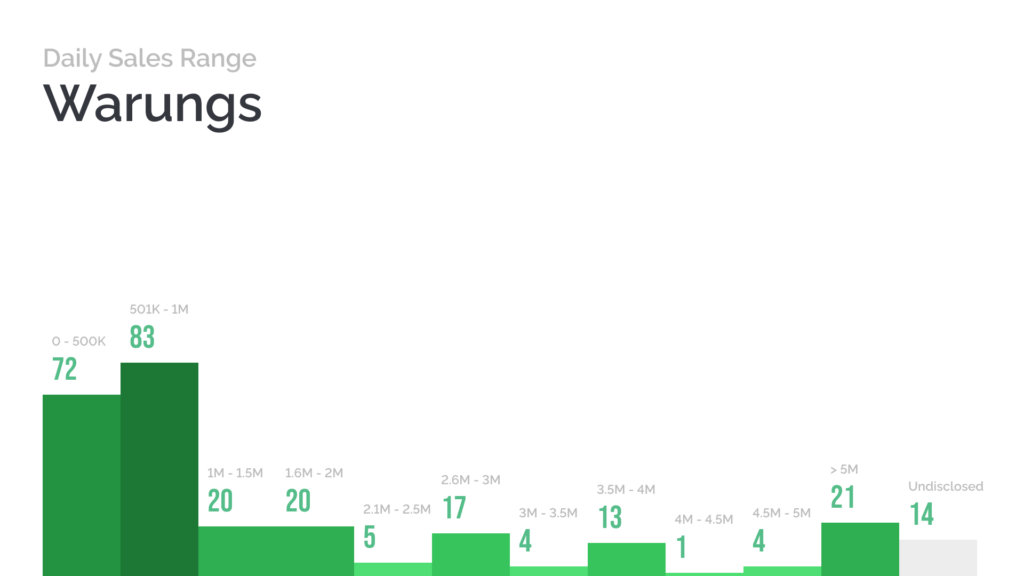
74% of the 273 warungs researched averaged daily sales between 500K–1M.
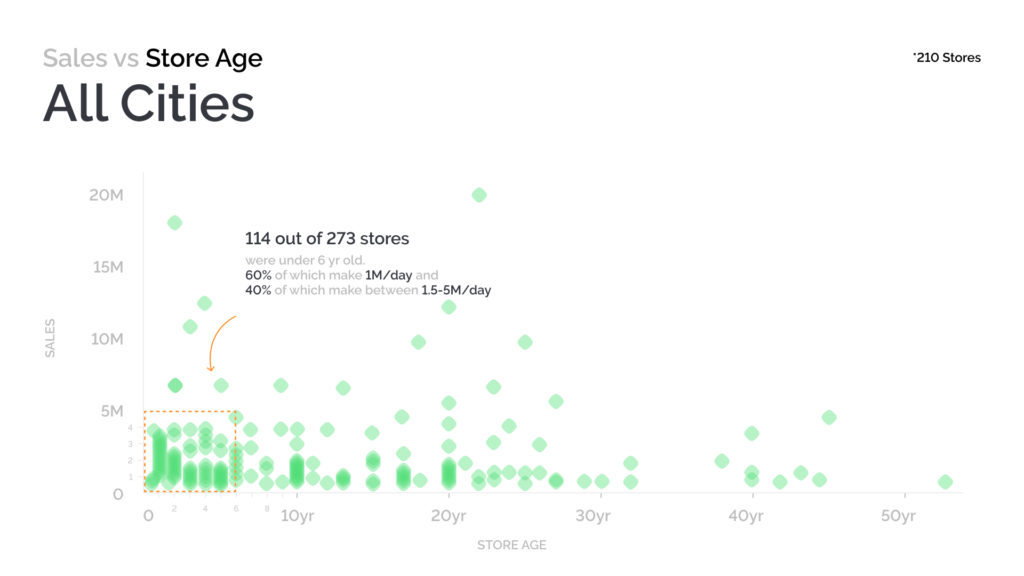
02) Store Age
Younger stores were already competing with established businesses. 41% of the warungs were less than 6 years old, while competing with older stores at similar sales levels.
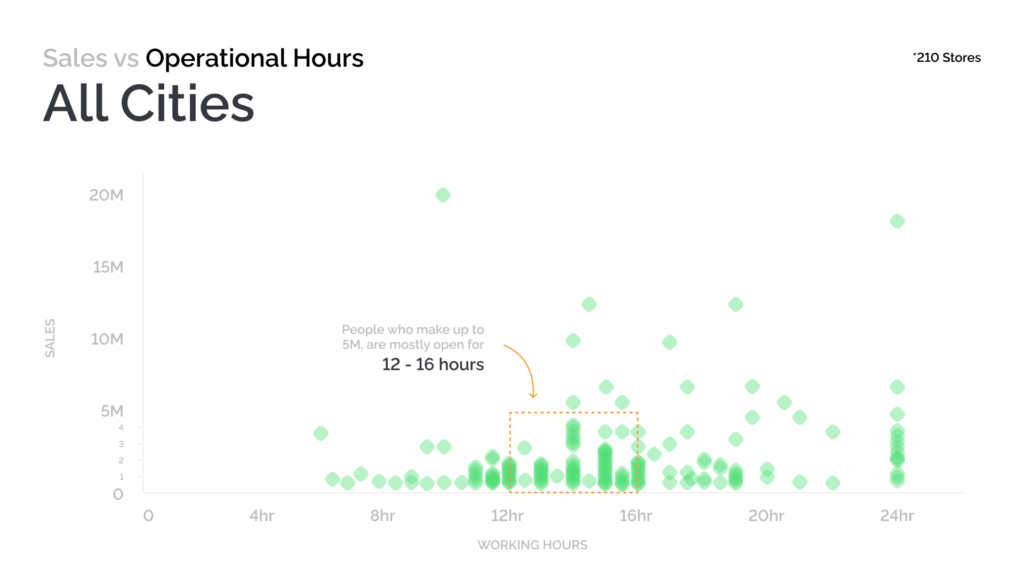
03) Operational Hours
Time invested in the business influenced sales potential. Stores operating around 12–16 hours per day tended to reach higher sales levels, with some approaching 5M.
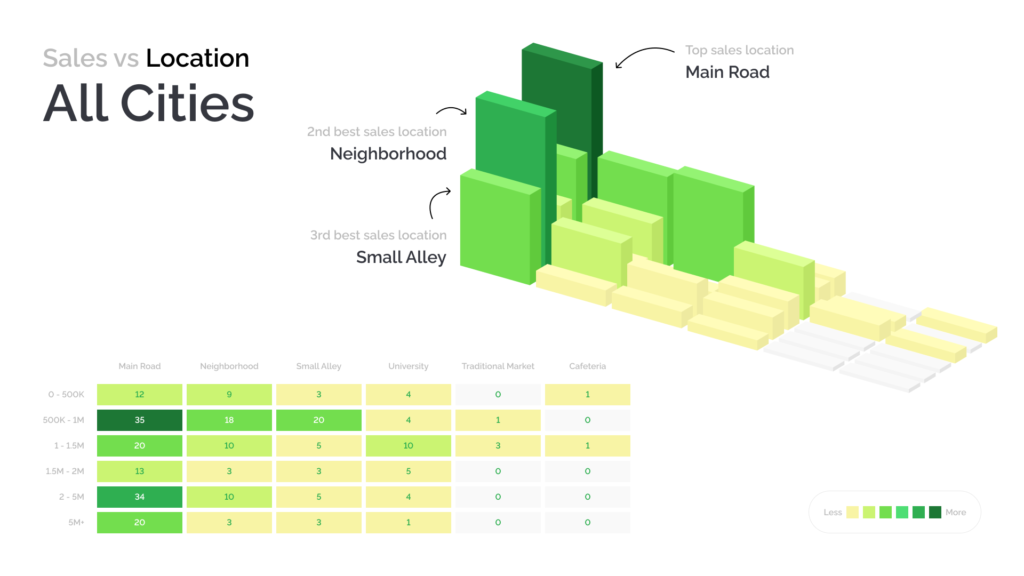
04) Location
Store operated also mattered. Main road stores generally saw higher sales due to visibility and access to both regular customers and passers-by.
05) From Operations to Behavioral Patterns
Among the 273 warungs visited, 134 displayed four key traits suggesting leadership potential, while 139 showed a more passive “follower” approach.
The synthesis revealed four behavioral characteristics associated with the Leader group:
Owners who built strong relationships with customers and their surrounding communities.
Owners who actively experimented, adapted and looked for ways to improve their business.
Owners whose motivation was strongly connected to family, community and social status.
Owners who actively adopted technology to support their business.
06) Evidence Behind the Framework
a) Socially Engaged
b) Entrepreneurial & Innovative
c) Community-Driven
d) Tech-Enabled
06. The Human Story Behind the Data
Technology adoption was not always about age
During the field research, one store particularly challenged my assumptions.
A warung was operated by a retired owner who opened the business to stay active during retirement.
What surprised me was how he managed inventory using a computer application developed by his son, who was a programmer.
For me, this was an important reminder:
07. What This Meant for Ula
The research was not intended to end with a research report.
The team synthesized the findings and prepared a presentation for company leadership and management.
The research became an input into several areas:
Which types of warung should Ula prioritize?
How can different types of retailers be understood?
Which retailers are more promising to acquire?
What capabilities or services could better support different retailer types?
What kind of treatment or programs could support “Leader” warungs?
Which hypotheses required deeper investigation?
Although I reached the final stage, I never received feedback on my submission despite requesting it. That experience reinforced my belief that thoughtful feedback is essential not only for improving design, but also for helping people grow throughout their careers.
Today, whenever I mentor designers or collaborate with teammates, I try to provide constructive feedback whenever possible because I know how valuable it can be.
08. Reflection
This project changed how I think about field research.
At the beginning, it was easy to think of each interview as an individual story. But with hundreds of stores being observed across different cities, the challenge became finding meaningful patterns without losing the context behind them.
I learned that research at scale requires two abilities at the same time:
Understand the individual person’s motivations and context.
Recognize patterns that can inform broader product and business decisions.
One of the strongest examples was the retired warung owner using a computer for inventory management. It reminded me that assumptions about users, especially assumptions based on age or demographics can easily hide opportunities.
![[GANTI INI: deskripsi gambar yang informatif]](https://andiastika.com/wp-content/uploads/2026/08/Locations.png)
![[GANTI INI: deskripsi gambar yang informatif]](https://andiastika.com/wp-content/uploads/2026/08/Documentation-2.jpg
)
![[GANTI INI: deskripsi gambar yang informatif]](https://andiastika.com/wp-content/uploads/2026/08/Documentation-1.jpg
)
![[GANTI INI: deskripsi gambar yang informatif]](https://andiastika.com/wp-content/uploads/2026/08/Social.png)
![[GANTI INI: deskripsi gambar yang informatif]](https://andiastika.com/wp-content/uploads/2026/08/Entrepreneur.png)
![[GANTI INI: deskripsi gambar yang informatif]](https://andiastika.com/wp-content/uploads/2026/08/Community.png)
![[GANTI INI: deskripsi gambar yang informatif]](https://andiastika.com/wp-content/uploads/2026/08/Tech-Enabled.png)