
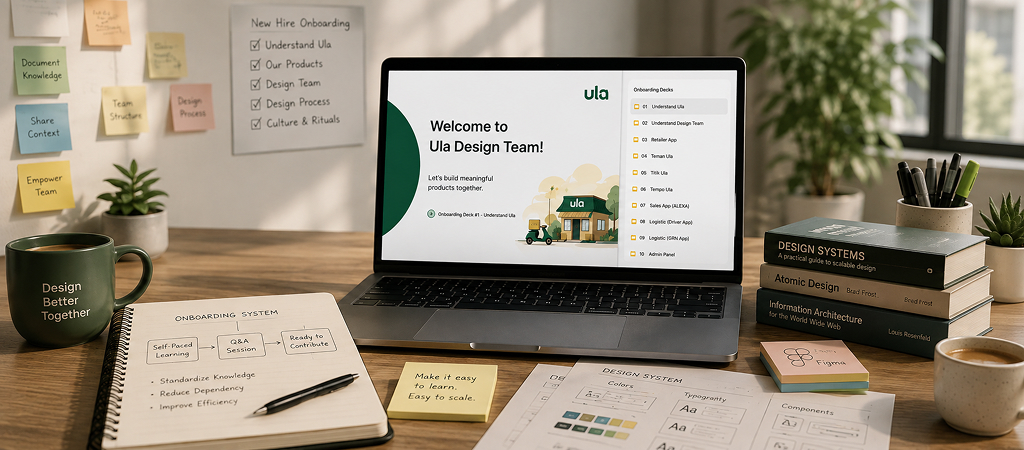
01. Overview
As Ula rapidly expanded its product ecosystem, the design team grew alongside it. New designers needed to understand not only the company and design culture, but also more than seven different products across multiple business units.
At the time, every onboarding session depended on me because I had been the first Product Designer at Ula and had accumulated most of the product and business knowledge over time. While this approach worked initially, it quickly became unsustainable as hiring increased.
To reduce onboarding time and remove knowledge dependency on a single person, I designed a structured onboarding system that enabled new designers to learn independently before joining focused Q&A sessions.
![[GANTI INI: deskripsi gambar yang informatif]](https://andiastika.com/wp-content/uploads/2026/08/02-SDTO.jpg)
02. The Challenge
When the design team consisted of only a few people, onboarding through live sessions was manageable. However, as Ula expanded, each new hire required hours of one-on-one knowledge transfer covering the business, design process, team culture, and every product within the ecosystem.
Because this knowledge largely existed in my head, onboarding became increasingly dependent on my availability. Preparing materials, scheduling sessions, and repeating the same explanations reduced the time I could spend on product work.
Together with the Design Manager, we identified that the real problem wasn’t the onboarding content, it was the onboarding process itself.
![[GANTI INI: deskripsi gambar yang informatif]](https://andiastika.com/wp-content/uploads/2026/08/03-SDTO.jpg)
03. My Contributions
Rather than simply documenting information, I redesigned the onboarding experience as a scalable system. My role extended beyond creating presentation slides to structuring knowledge, defining learning sequences, and enabling other designers to participate in the onboarding process.
Created ten onboarding modules covering company context, design practices, team culture, and every major product.
Organized onboarding into a logical progression, allowing new designers to understand the business before exploring individual products.
Consolidated previously scattered information into a single, reusable onboarding resource.
Shifted onboarding away from a single instructor by enabling self-paced learning followed by live Q&A sessions.
Worked closely with HR and the Design Manager throughout recruitment and onboarding, helping new designers integrate into the team more efficiently.
04. Outcome
The onboarding system significantly reduced the amount of synchronous onboarding required for every new designer.
Instead of spending approximately sixteen hours walking through every topic live, new hires completed the onboarding materials independently before joining shorter discussion sessions focused on questions and clarification.
Although Ula later paused hiring due to company restructuring, the documentation became a reusable knowledge base that no longer depended on a single person to deliver.
![[GANTI INI: deskripsi gambar yang informatif]](https://andiastika.com/wp-content/uploads/2026/08/04-SDTO.jpg
)
05. Reflection
This project reshaped how I think about design.
Initially, I believed onboarding was simply about explaining information to new teammates. Over time, I realized the real challenge wasn’t transferring knowledge, it was designing a process that could continue working without depending on one person.
The experience reinforced an important principle that I continue to apply today: documentation is a product. Like any product, it has users, solves specific problems, and should be intentionally designed to reduce friction.
Looking back, this project taught me that scaling a team isn’t only about hiring more people. It’s about building systems that allow knowledge, decisions, and ways of working to scale alongside the organization.
"Scaling people starts with scaling knowledge."
Want to discuss this project?
I’d love to talk through the process, the decisions, and the lessons learned.